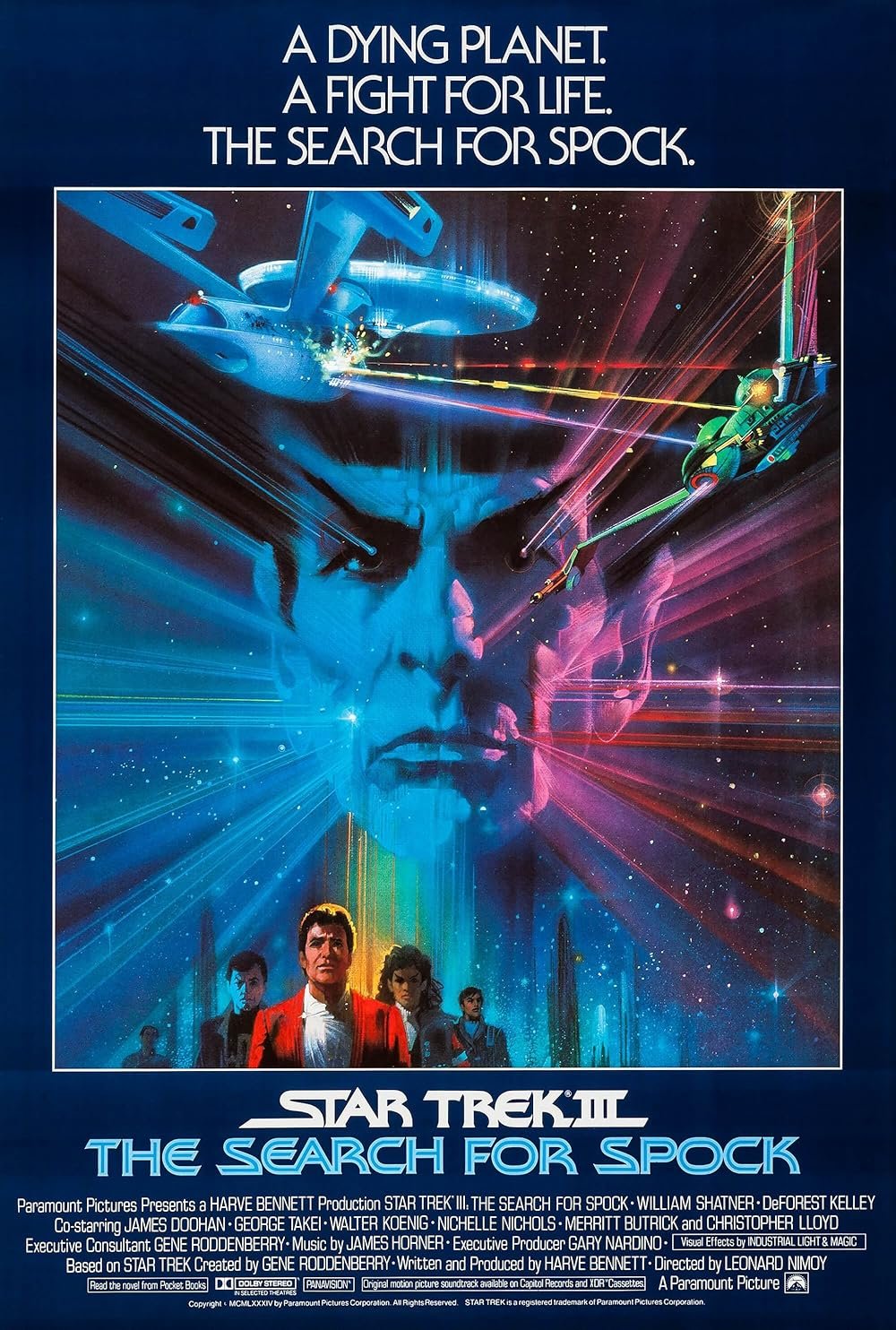
Star Trek III: The Search For Spock (1984) Movie Info
| Field | Details |
|---|---|
| Movie Name | Star Trek III: The Search for Spock (1984) |
| Director | Leonard Nimoy |
| Screenplay Writer | Harve Bennett |
| Based on Novel by | Based on Star Trek created by Gene Roddenberry |
| Lead Actors | William Shatner, Leonard Nimoy, DeForest Kelley |
| Cast | William Shatner, Leonard Nimoy, DeForest Kelley, James Doohan, George Takei, Walter Koenig, Nichelle Nichols, Christopher Lloyd, Robin Curtis |
| Genre | Science Fiction, Adventure |
| Release Date | June 1, 1984 (United States) |
| Duration | 1h 45m (105 minutes) |
| Budget | ~$16 million |
| Language | English |
| Country | United States |
| Box Office (Worldwide) | ~$76.5 million |
WATCH NOW

Summary
Spock’s dead, the Klingons want the Genesis device, but who cares, really?
Review
Outside of a few moments, Star Trek III feels more like a TV movie than a Trek film in its own right. Yes, the setup is 24k gold Spock may or may not be alive and his father has asked Kirk to go to the Genesis planet anyway to retrieve his body so they can deposit his katra (or soul) at Mount Seleya, the Vulcan equivalent of Mecca. While Kirk is thinking about stealing the now-decommissioned Enterprise to take care of this errand, the Klingons have decided to see what all the hubbub in the second flick was about and find out about the Genesis project and think to themselves that it would make a dandy weapon. However, this is much better told as a bar anecdote than the movie itself, which seems to stretch far longer than its 105 minute running time while at the same time feeling like it’s being rushed. You can point at Spock for this, even if he’s not in the movie for the most part it’s Nimoy’s first outing as a director.
A sloppily written script with more than a few holes (the reason for stealing the Enterprise is nebulous at best as they discover Spock’s katra isn’t where it’s supposed to be early on in the film the decommission of a fairly recently refurbished ship, etc) along with acting that is generally not what it was in the second film makes the scenes that have genuine impact less resonant with the viewer. Still, not all is lost, as the theme of Trek’s “family” always plays well and the end of the movie tugs on the heart strings just enough. Of special note is Christopher Lloyd, whose rough voiced Kruge is the model of a very modern Klingon commander, making it hard to believe he played Reverend Jim and Doc Brown.
Also Watch.